
GlasPort Bio
GasAbate
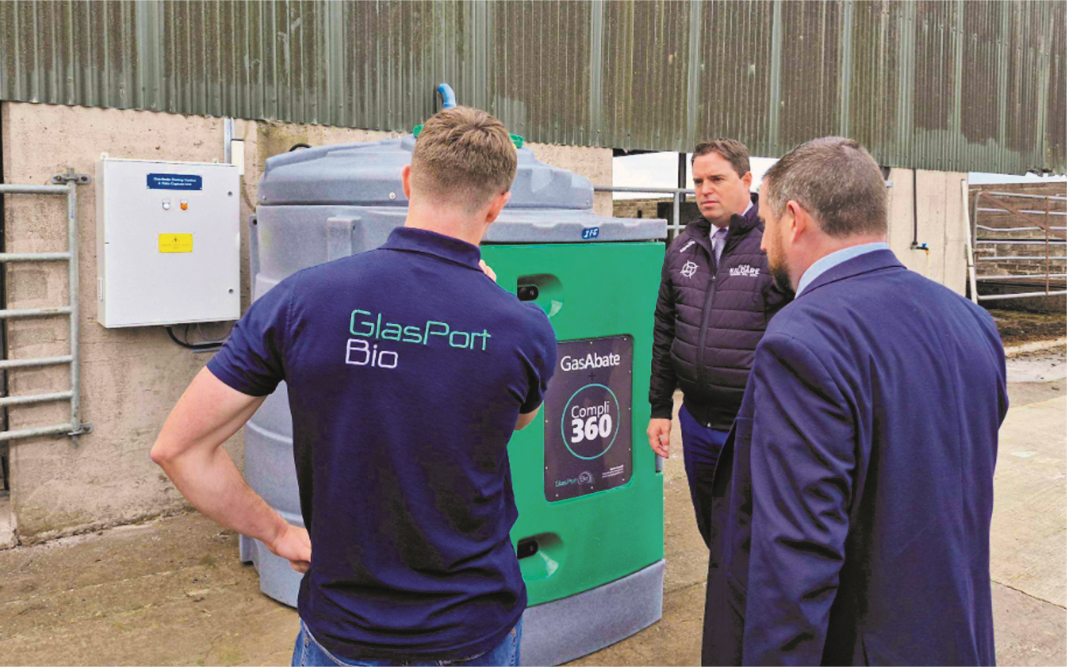

Minister for Agriculture, Food and the Marine Martin Heydon TD visited the Farm Zero C project at Shinagh Farm this week and saw first-hand how the GasAbate system is helping farmers reduce greenhouse gas emissions from slurry.
The Minister was joined by Karl Walsh, Head of Research, Bioeconomy and Codex, and Patrick Barrett, Bioeconomy and AKIS Policy Specialist, where he toured the farm and received a demonstration of the fully automated system.
Stephen Fagan of GlasPort Bio takes the Minister through how GasAbate+Compli360 works.
The visit highlighted how research backed by the Department of Agriculture, Food and the Marine has progressed from early-stage trials to commercial deployment on dairy farms. Early validation through the Department's Meth-Abate and LabMaCC research projects helped lay the foundations for the technology now being rolled out across Ireland and Europe.
Shinagh Farm is one of 10 Carbery farms currently operating the GasAbate system, with almost 20 more farms set to join the programme in the coming months.
Farmers participating in the Carbery-Climate KIC programme are achieving significant emissions reductions from slurry management. Independent verification by the Carbon Trust has shown methane emissions reductions of 78%, while hydrogen sulphide is reduced by approximately 80% and ammonia emissions by up to 50%.
Beyond the environmental benefits, the technology is also delivering practical advantages for farmers.
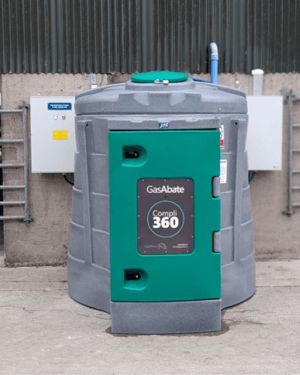
Research carried out by Queen's University Belfast earlier this year found that grassland treated with GasAbate-treated pig slurry produced 21% more dry matter than untreated stored slurry. Increased grass growth can help reduce reliance on chemical fertilisers, improving both farm profitability and sustainability.
GasAbate-treated slurry also requires substantially less agitation before spreading, reducing labour requirements and helping farmers save time, fuel and machinery costs.
Today, farmers in Ireland, Sweden, Switzerland, the Netherlands and France are adopting GasAbate technology to deliver measurable on-farm emissions reductions while improving the management and value of their slurry resources. By the end of this year, GasAbate will be installed on almost 100 farms and cutting emissions on 500,000t of slurry.
GlasPort Bio was delighted to show Minister Heydon a practical technology that can help agriculture reduce emissions while maintaining productive and profitable farming systems.
Speaking after the open day, Padraig Walsh, Farm Zero C Project Manager at Carbery Group, said: "We were delighted to welcome farmers and Minister Heydon to Shinagh for our biannual open day. The Shinagh open day provides attendees with an update on farm performance and how the farm’s carbon footprint is being reduced through the Farm Zero C project.
"Shinagh has been treating winter slurry with GasAbate for several years and we have recently upgraded our dosing system, and it was great to showcase this on the day. Our partnership with GlasPort Bio and ClimateKIC has enabled us to scale GasAbate on to more Carbery farms, and we hope to have almost 30 installed by end of the year in West Cork."